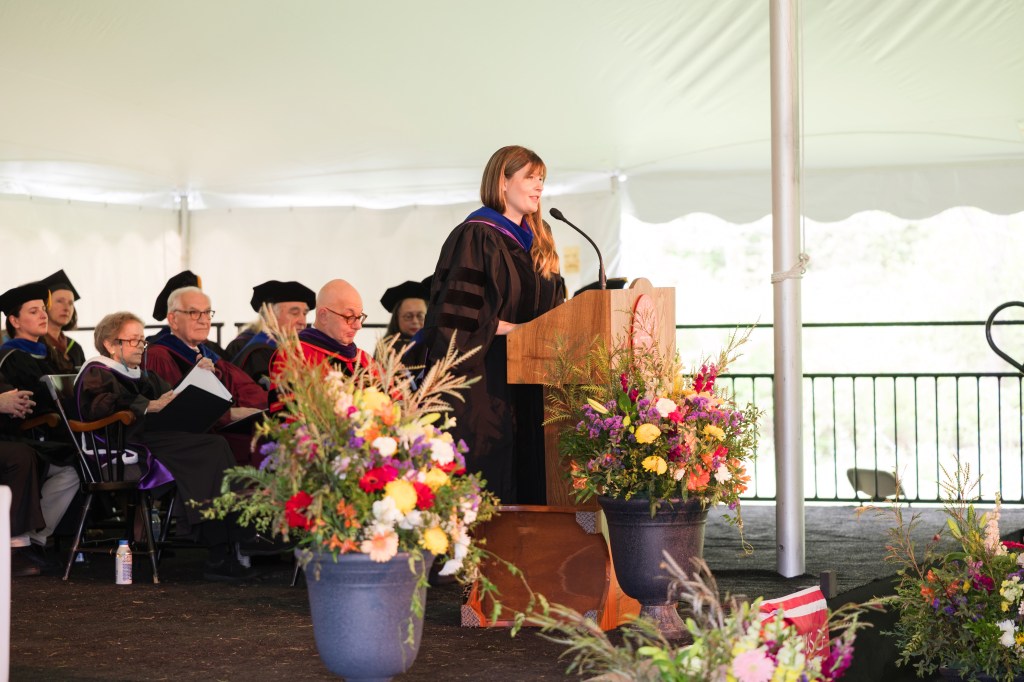
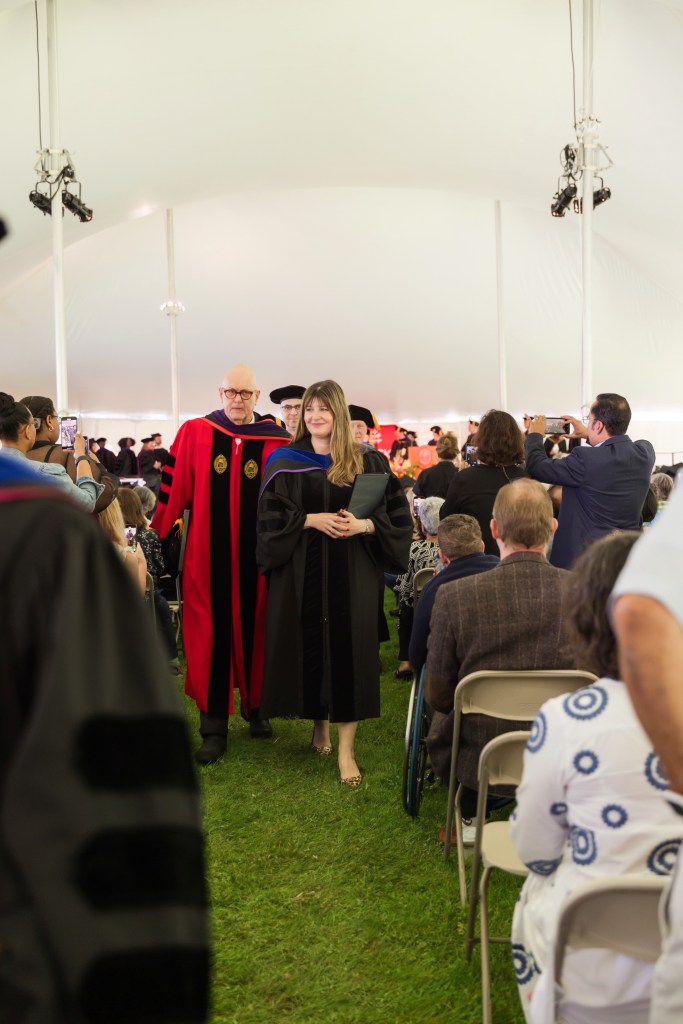
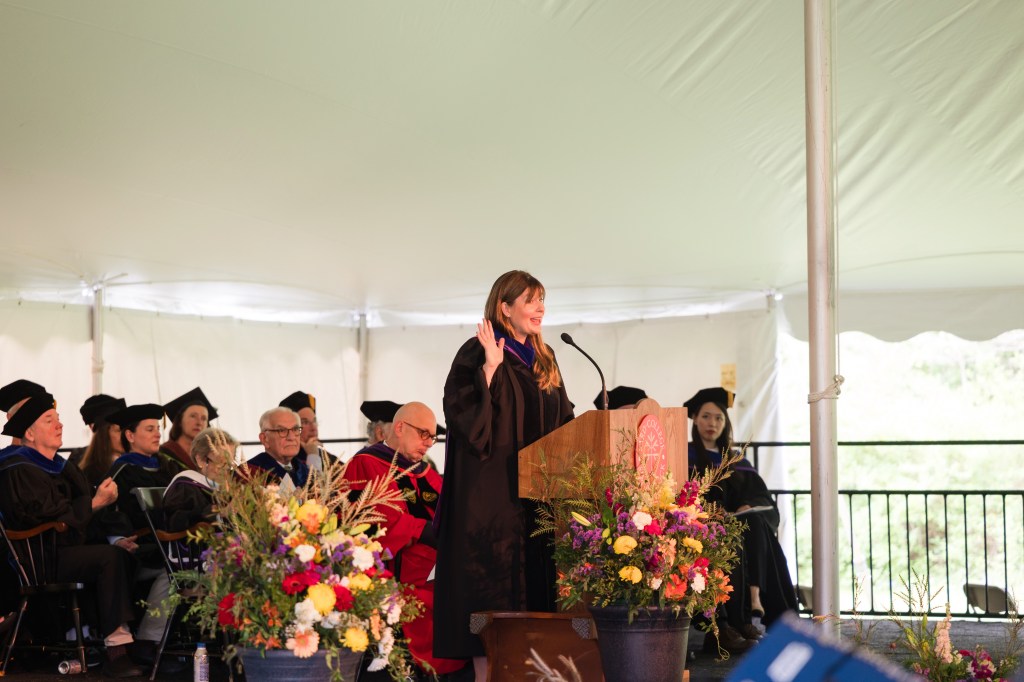
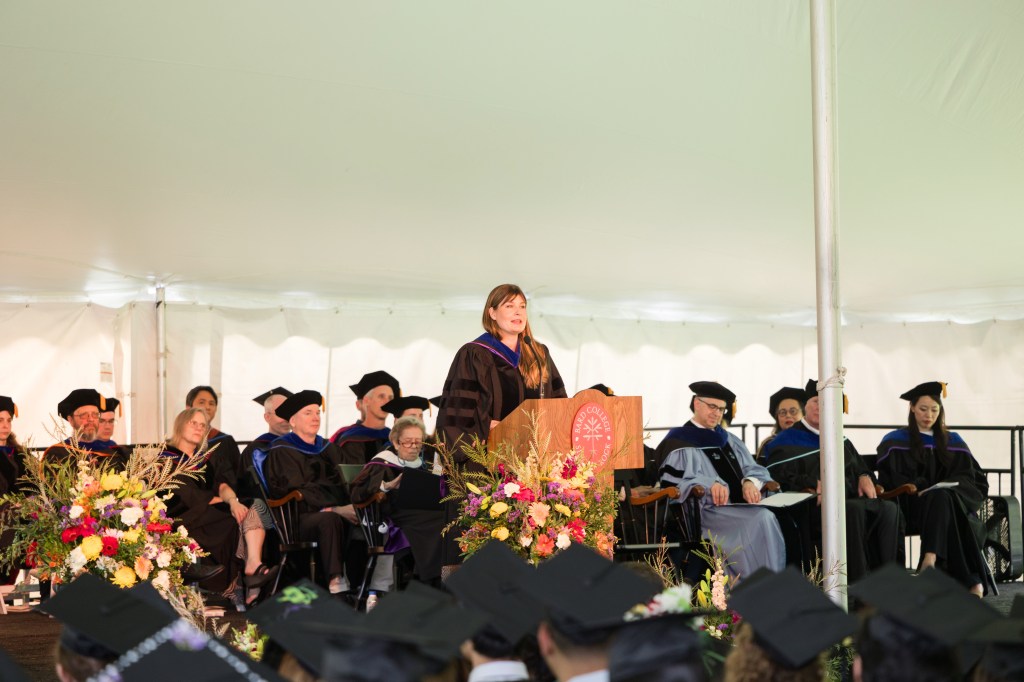
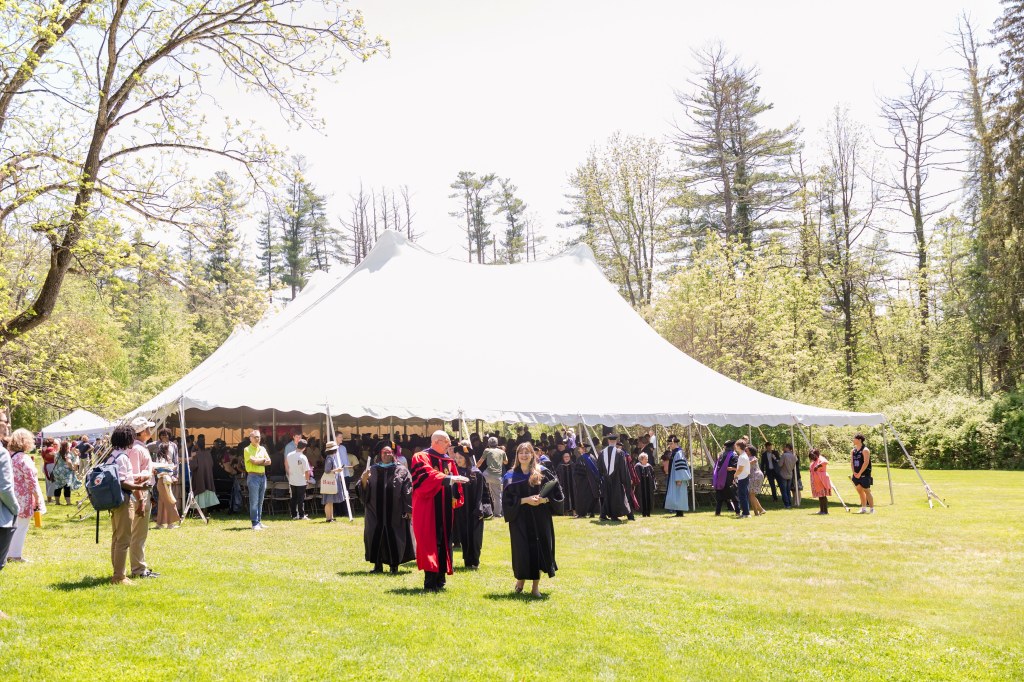
It was the honor of a lifetime to be invited to speak at the 2025 Commencement Ceremony for my undergraduate alma mater, Bard College at Simon’s Rock in Great Barrington, MA.
Here is the video of Commencement and the speech begins at 16:45.
Below is the full text of the speech.
Thank you. It is an honor and privilege to be here to address today’s graduates. 20 years ago, I walked in your Birkenstocks, I mean shoes. I graduated in 2005. Graduates — raise your hand if you were even born in 2005. Yeah, nothing like an early college to keep you humble.
I would like to thank the devoted, tireless faculty and staff, the parents, friends and families, Dr. Botstein, Jamie, Emily and everyone on the Board of overseers who have given so very much of their resources, time and dedication to this institution and among whose ranks it was a privilege to serve from 2019-2024. Above all, I would like to thank Provost John Weinstein for this invitation. His energy and creativity are inspiring. But I actually knew him way back when during his first tenure here at Simon’s Rock as a young professor and we even worked on several theater productions together. Friends, he has made many courageous and hard choices as our leader but they all pale in comparison to bringing a musical, even a Sondheim musical, onto this campus. That was truly an act of daring courage.
In preparing for this speech, after a prolonged period of dwelling in the paralysis of unrealistic expectations, I did my homework. Like any good student does — I asked ChatGPT to write it for me. No. I watched famous commencement speeches. But Winston Churchill and Taylor Swift don’t need to explain who they are. I tried searching for brilliant commencement advice from non-famous people, but the algorithm didn’t know what to do with that – it gave me Katie Couric and Michelle Obama. If they are not considered famous, I’m in trouble. Finally, I spoke to my stepfather Walter, a sage retired professor with a wizard-like white beard who has seen many a commencement and who advised me quite simply to tell you my story.
So I started to think back to my time here, and at first, I was embarrassed by how naïve, impractical and inefficient my decisions seem from today’s vantage point. When I woke in a panic after not having completed this draft — or maybe from listened to too many podcasts about how AI god machines and oligarchic overlords are going to render us all obsolete by next year anyway – I realized that finding the meaning in the hopeless imperfection may actually be the point. I see that it is the very humanness of my story that matters.
When I reflect on my winding career path, I start to see the throughline. I see how choosing this unique school and surrounding myself with like-minded, stubborn, different people who are not afraid to ask questions, helped me later shatter the low expectations put on a young woman knocking on the door of a good ol’ boy’s club. And in a world that is changing more rapidly than in any other age of technological revolution – these things that mark us as ‘different’ are important more than ever. They are our humanity in all its glorious inefficiency. Because ChatGPT can write an essay for you in seconds – an efficient output to be sure, but it cannot do the learning for you, it cannot take you on the journey and that is the outcome that makes us grow. It is the process itself that makes us effective. Efficiency is no guarantee of efficacy.
So, my story. My parents were Serbian immigrants whose families landed in the United States on grounds of religious asylum. They were raised in a small pacifist sect, which is not an easy position in the Balkan powder keg. America offered safety and opportunity, but it is not so easy to navigate a new culture without a local support structure. We moved around a lot, which isolated me from the kind of community support that might have helped me find a more direct path. I was bullied pretty badly as the bookworm who read Little Women fifteen times, wandered the woods like Eowyn battling imaginary orcs, and skipping class only to head to the library to check out books on Elizabethan history or the science of hemophilia…This is a safe space, right?
My beautiful big sister, back there, is still embarrassed about it. But she eventually married a Rocker, so I guess she came ‘round!
But, back to me. After living in five towns across three states, my mother, sister and I moved to South Egremont and I enrolled at Mount Everett. They didn’t have a formal relationship with Simon’s Rock like they thankfully do now and they didn’t quite know what to do with me beyond having me skip sixth grade and then pretty much leaving me to my own devices and the support of a couple of excellent teachers.
I knew Simon’s Rock was the place for me since then, but there was no Bard Academy at the time, and I had to wait to apply until the ripe old age of fifteen so I wouldn’t be a total social pariah like you know, Ronan Farrow who actually did enroll at eleven. Ronan, if you hear about this, please don’t research a tell-all book about me, okay?
Halfway through my first year, my mother moved to New York for a job, so for the remainder of my studies, I stayed with a series of wonderful family friends, served as an au pair for a time, and even walked to campus (uphill! Both ways! — actually on Hurlburt Road, this is true) until the day I was old enough to drive a car. As a day student, I missed a lot of the formative experiences that one has on campus – the late-night confessions in Crosby, the endless video games played in Dolliver, and whatever happens in Kendrick stays in Kendrick.
It was here at Simon’s Rock that I finally started building a community of my own among curious sharp minds in search of a different experience, but they were an intimidating bunch, who all seemed to know a lot more stuff than me – especially those poli sci kids who actually understood, or at least seemed to understand, pretty much everything. But I showed them with my work ethic! I triple-majored. I may have been the reason they stopped allowing this. Worse, all the majors were impractical, so this is where I give thanks for my one-in-a-million, supportive mother and her patience with my bullheadedness.
The first major was European Studies. This included my languages – French and Spanish – as well as pretty much everything I studied during my year abroad in Paris. Today, I provide geopolitical risk advice to a public French company on their Global Advisory Board. Beyond the obvious criteria, there was another perhaps less obvious reason that I was chosen to advise alongside CEOs of public companies and retired ambassadors. Because I speak French, a skill that made the French executives more comfortable with me in the social context that surrounds the formal meetings, the sidebar chats, the long drives out to visit new hydrogen power factories. Shoutout to the luminescent Maryann Tebben for introducing me to Sartre, tutoring me one-on-one through the plays of Moliere and graciously serving as my thesis advisor!
The second major was literature. The legendary Hal Holladay was known for saying “a C for you, a B for me, and A for God and Shakespeare”. With all the arrogance of youth, I decided to take Shakespeare with him in my first semester anyway—an experience worth every bit of that B+, even if that grade still rankles. Hal was also known for completely rewriting your essays in the margins of your paper, which was an incredible teaching investment of time and energy. Today, I deploy these writing skills for my regular Forbes column. Shakespeare it is not, but I use what I learned here — to apply my curiosity systematically and with rigor to the topic at hand. I also got this post in the first place via a contact from the Simon’s Rock alumni network. GenAI may be able to write your job application for you, but I’m here to tell you that I have NEVER gotten a job through an application. They all came through conversations, through people and through having sthe gumption to raise my hand and say ‘how ‘bout me?’
The last but most visible major was theater performance, the least practical and yet somehow the most useful major of all. This is where I learned the so-called soft skills, which are totally undervalued – even dubbing them ‘soft’ makes them sound kind of irrelevant. Do you know how to listen and how to communicate when it’s your turn? You learn that in improv or you lose your pants! Do you understand what motivates people, how to read the subtext? That’s scene study. Do you understand the shape you make in space? I studied this in viewpoints. In clown class. How can you use this to position yourself for success and to actualize the impact you want to make?
On my very last day of classes with no job and no prospects in sight, the Chester Theatre Company came to Simon’s Rock to audition the theater graduates for their young company and four of us landed offers. I jumped at the opportunity to make $150 a week, share a small house in Westfield the Bestfield, Massachusetts, and live off 10¢ ramen.
Six months later, we decided to form our own company, ultimately leading to a successful off-Broadway show and landing us in this week in theater and a rave review from The New York Times. The real joy of this experience was that I had the privilege of building something original alongside my best friends. As all theater is, it was temporary. We brought humans together in a room for the thrill of a shared, passing experience. No phones, no TikTok algorithm, just community. This experience took up fully two years of our lives and all our Rocker creativity. To this day, these are still my best friends and most beautiful of all, our children are now forming friendships of their own.
And then it ended, and I went back to auditioning for a bit part in someone else’s vision. This was not the inspiring Simon’s Rock theater bubble of headlining Tennesse William’s Suddenly Last Summer or taking on Portia in The Merchant of Venice or Sara Katzoff’s thesis in which I played a markenflacher with no lines but with a killer pair of zebra-skin stilettos. No, the fare on offer was more…prosaic. One day, I showed up to audition for of all things, a toothpaste commercial. In the waiting room were 50 other blondish girls in white t-shirts wearing red lipstick and it landed on me — I was completely and totally REPLACEABLE. So where was my meaning going to come from? It certainly wasn’t going to come from selling toothpaste. It had to come from me. I had to find out what was irreplaceable to me.
And then the irreplaceable came along in human form. As you know, the dating scene at Simon’s Rock is small and well, complicated. And later when the social ranking question of “where did you go to college?” inevitably comes up on dates, that too is complicated for us. When I met my future husband, Jason, I sighed and geared myself up to launch into it. But he cut me off, “yeah, I know Simon’s Rock”. Graduates, I was speechless. It turns out that he attended the summer writing and thinking workshop and credits it with bringing him out of his shell. I prefer not to clarify whether it was the discussions of Nietzsche or the late-night skinny dipping in Lake Mansfield that did it. Perhaps it was the late-night discussions of Nietzsche while skinny dipping. He is a man of many talents, a liberal arts-style portfolio career and the person I can reliably go to on any subject from politics to sports to arts to anxiety. I can’t think of a better role model for our two beautiful sons – Emmanuel (4) and Baby Walter (2 months!)!
I worked a great number of random jobs in this period: a costume shop stitcher at Shakespeare & Company; a substitute teacher – a harder $50 a day has never been earned than by a 19 year old college graduate trying to exercise authority over high school students; a traveling Dove spokesmodel in a Wal-mart near you (to this day, the most grueling job interview I’ve ever had!), but in which I observed the daily rhythm of communities and learned to talk to strangers. Also, how to buy khakis. Eventually I found a personal assistant agency on Craig’s List and they shipped me out to Disaster Recovery Institute International, the leading nonprofit professional association that helps organizations prepare for and recover from disasters. We provided training services in operational risk, business continuity, pandemic preparedness, and cyber resilience primarily for financial services, tech, healthcare, government agencies including many central banks, and consulting firms. I thought I was going to work there for one day. Nine years later I was named CEO.
I started out assisting the then Executive Director. As part of the deal, he would take me out to lunch whenever I came to the office. This was invaluable because I got a much-needed free lunch and also because I got to ask questions about what mattered to the company. What was he worried about? How could I help? I listened and learned that DRI had been founded and governed by narrowly-focused, highly-technical industry professionals, whose skills were very different than mine. I could be a gap filler, connecting the dots and communicating the value proposition. They actually needed a generalist’s vision and here I was in my Shakespearean hero cape — liberal arts grad to save the day!
I developed a passion for the work of protecting our communities from the impact of crises like hurricanes, terrorism and cyberattacks. The mission imbued the sometimes boring daily work with meaning. Jumping in with both feet, I proved myself by figuring out problems and proposing solutions that I could provide. Was I good at languages? Yes. Did this mean that our Call Center Head – a beauty queen with a thick Arkansas accent and our Dominican bookkeeper in New York would use me as a translator because I could understand both accents? Yes. We were negotiating contracts with partners to introduce our training courses abroad. Did I know that South Africa is not in Latin America? Yes. Did I think to Google stuff I didn’t understand instead of pestering the boss? Yes. Graduates, not everyone is a Rocker out there. It’s amazing what you can do by showing a little entrepreneurialism and initiative, by thinking critically and creatively.
A few months later we were doing strategic planning, and I pitched that someone should be dedicated to the international practice full time, as it had much more potential. I did not expect that they would offer it to me – I mean, I was 23. But they did and I became Director of Global Operations, working to grow our presence outside the U.S. to 40% of the business in 5 years and acting as our international spokeswoman, a role that took me to dozens of countries across six continents. In that role and later as Executive Director, I used all those theater and liberal arts skills to give presentations, to initiate conversations with strangers in the conference coffee line, to capture the attention of policymakers so they would understand the importance of our mission. I used them to generate media attention on a shoestring budget landing me on every major network over the next few years to help bolster the personal preparedness of the public.
In 2017, I was elected by the board in a unanimous vote to serve as President and CEO, the youngest and first woman since the organization was founded in the 1980s. During my tenure, we doubled in size to support over 20,000 members across 110 countries in the public and private sector alike, including at 95% of Fortune 100 and 60% of Global 2000 companies. We led the global conversation about how to plan for our darkest times and how we can safeguard lives, livelihoods and communities to build back better for a more resilient future. During the Covid-19 pandemic, our work became more visible and more vital than ever.
I got to build a relationship with the UN Office for Disaster Risk Reduction with the goal of leveraging the private sector to reduce disasters and then filled a similar function for the US government as a member of the FEMA National Advisory Council, which advises the FEMA Administrator on all aspects of emergency management. I was honored to serve my country and support the cause of national preparedness and resilience. At least until we all got DOGE’d.
One of the most difficult struggles a human will face is knowing when to walk away. Last year, I made the excruciating decision to step down from DRI. Change, while challenging, is essential for continued growth. I made this decision for many reasons. Primarily it was driven by the belief that new leadership would bring fresh perspectives, ideas, and energy to propel the organization forward while building on a foundation of strength. On a personal level, being chosen to lead was the honor of a lifetime, but careers are long. To everything, there is a season – part of leadership is knowing when to change with that season.
To figure out what’s next, I’ve first found my way back to the classroom. As Executive in Residence and professor heading the Global Economy concentration at the NYU Center for Global Affairs, I am building on this work in expansive, exciting and challenging ways. From an academic perch, I can spend time researching how to bring the future forward and to better understand how systems respond effectively in crisis, work that feels all too meaningful these days.
Careers are a marathon, not a sprint, and different priorities will arise at different points along the way. In a polycrisis world, big changes are coming. Out of chaos comes opportunity, so it is essential to stay curious, keep learning and figure out how to be useful so you can be the one to seize it. It is learning itself that you must learn to love. It may not be an efficient process. It certainly wasn’t for me. But it has never been more important to do what is hard and what may feel inefficient, because it is the journey with all of its trials and tribulations, with all of its profound humanness, that makes the meaning.
None of us came to Simon’s Rock to live a conventional life. We’re not conventional. We’re Rockers. We question everything. How will you define success? Will it be because you got a good job? In another twenty years, will we even define ourselves around work anymore? How will you define meaning for yourself and help your community to find it as well?
What matters most is what we do with these ephemeral moments that we build together. How do you show up for the people in your life? Do you make space for community, to take care of someone? Maybe do it now. Maybe give the person next to you a consensual hug or a pat on the back, a smile. A machine can’t do that.
Nothing is eternal, not even this beautiful campus and the rock for which it is named. Today we say goodbye, but these traditions will be carried onward to a new home on the Massena campus and onward in our hearts. Let us take a moment of silence to listen to the birdsong and offer gratitude for this place that has held us through so many years of learning, reflection, and growth.
And so my dear graduates, my fellow Rockers, we don’t know what the future holds. All we can control is our preparation for it and our reaction to it. Cherish your inefficiency. Seize the moment of joy. Stay present. Stay curious. Keep learning. Savor this day because it is yours. Graduates of 2025, congratulations!
 Edgewood Insights